
PJM 2027/2028 Base Residual Auction Clears at Price Cap
PJM 2027/2028 Base Residual Auction Clears at Price Cap
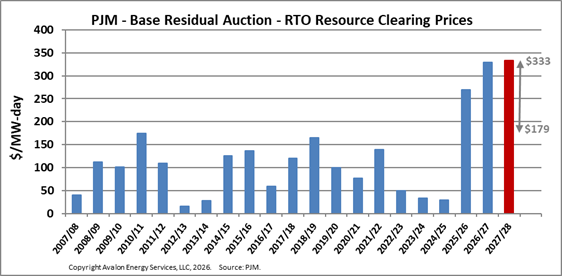
In December 2025, PJM announced the results of its 2027/2028 Base Residual Auction (BRA), with the clearing price reaching the cap of $333.34/MW‑day across the RTO. In total, PJM procured 134,479 MW of Unforced Capacity (UCAP) through the auction.
The graph below shows the history of RTO clearing prices. The price cap and floor shown on the right side of the chart were negotiated for the 2026/2027 and 2027/2028 auctions. It remains uncertain whether these parameters will be retained, modified, or eliminated in future BRAs.
Prices with No Cap
PJM also released a simulation illustrating what clearing prices would have been without the cap. Under those conditions, RTO prices would have reached $529.80/MW‑day, with the Dominion Zone clearing at $542.83/MW‑day. The modeled reserve margin under this scenario would have increased to 15.4%.
ICAP versus UCAP
Understanding the difference between ICAP and UCAP is essential for interpreting the BRA results.
- ICAP (Installed Capacity) represents a unit’s nameplate or seasonal rated capability. It does not account for forced outage risk—essentially, “How much capacity does the unit have on paper?”
- UCAP (Unforced Capacity) adjusts ICAP for forced outage rates (EFORd). UCAP is the accredited capacity PJM counts toward reliability.
UCAP = ICAP x (1-EFORd)
PJM uses UCAP because it reflects the expected availability of a resource during system stress conditions. Two units with identical ICAP values may have very different UCAP values depending on their outage performance.
Based on reasonable assumptions for average EFORd across the cleared fleet, the implied ICAP associated with the 2027/2028 BRA procurement is approximately 142–149 GW.
Context: PJM Peak Demand
During the summer of 2025, PJM’s highest coincident peak demand reached 160,153 MW (June 23, 2025, HE 18)—nearly 20% higher than the UCAP procured for 2027/2028. This naturally raises the question: How does PJM meet actual peak demand when it exceeds the capacity secured through its BRAs?
Our last blog explores this question in detail. Here’s the link.
If you have questions about how any of this will affect your electricity bill or how you might manage your energy supply costs, please contact us.
The Avalon Advantage – Visit our website at www.avalonenergy.us, call us at 888-484-8096, or email us at info@avalonenergy.us.
Please feel free to share this article. If you do, please email or post the web link. Unauthorized copying, retransmission, or republication is prohibited.
Copyright 2026 by Avalon Energy® Services LLC